
“How much should I feed my dog?” is one of the most searched pet questions in the world, and for good reason. Feed too little and your dog will be hungry, under-nourished and possibly unwell. Feed too much and the extra weight builds up slowly, often unnoticed, until it starts to affect their joints, heart and lifespan. The feeding table printed on the bag is a reasonable starting point, but it was written for an imaginary average dog, not for yours. In this guide we explain how to work out the right dog food portion size, why the bag so often gets it wrong, and how our free Dog Food Portions calculator turns your dog’s real needs into an exact amount in grams per meal.
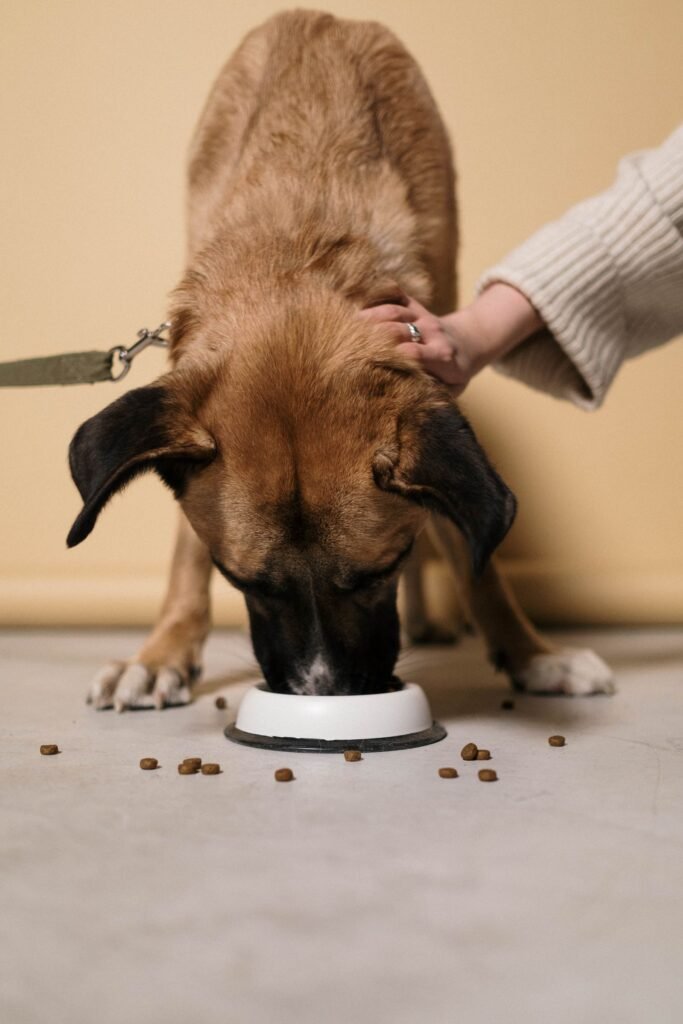
Why “feed according to the bag” overfeeds most dogs
Pet food manufacturers have to write a feeding guide that covers every dog that might eat their product. To make sure no dog is under-fed, those guides tend to assume an active, entire (un-neutered) adult with no treats in their diet. The reality in most homes is very different. The typical pet dog is neutered, walks for an hour or less a day, and receives a steady trickle of treats, chews and leftovers. Neutering alone can reduce energy needs by around a fifth or more. Put those factors together and many dogs following the bag are eating noticeably more than they burn.
Feeding ranges on packaging are also wide. A guide that says “250–350 g for a 25 kg dog” leaves a 100 g difference, which can be several hundred calories a day. Owners naturally pick the middle or top of the range, and the dog slowly gains weight.
The solution is to start from your dog’s actual calorie requirement and then convert that into the weight of your specific food. That is exactly what the Food Portions tool does.
Step one: work out your dog’s daily calorie needs
Every portion calculation starts with energy. Vets use the Resting Energy Requirement formula:
RER = 70 × (body weight in kg)0.75
This is then multiplied by a life-stage and activity factor to give the daily requirement. A neutered adult with typical activity is usually around 1.6 × RER; an entire adult around 1.8; puppies 2.0 to 3.0; dogs that need to lose weight around 1.0 × RER at their target weight. If you would like to understand this step in depth, read our guide to the Dog Calorie Calculator, which explains every factor in detail.
| Dog weight | Neutered adult, typical activity (kcal/day) |
|---|---|
| 5 kg | about 375 |
| 10 kg | about 630 |
| 20 kg | about 1,060 |
| 30 kg | about 1,435 |
| 40 kg | about 1,780 |
Step two: find the energy density of your food
This is the step most owners skip, and it is the most important. Dog foods vary enormously in how many calories they pack into each gram. A light or weight-management kibble might contain around 3,000 to 3,300 kcal per kilogram, while a performance or puppy food can exceed 4,000 kcal per kilogram. Wet foods contain a lot of water, so they usually fall somewhere around 700 to 1,200 kcal per kilogram. The same 200 g portion can therefore deliver wildly different amounts of energy depending on what is in the bowl.
You will usually find the energy content on the packaging, often listed as “metabolisable energy” in kcal per kg, kcal per 100 g or kcal per cup. If it is not printed, check the manufacturer’s website or contact their customer service team; reputable brands will tell you.
Converting between units
- kcal per kg ÷ 10 = kcal per 100 g (e.g. 3,700 kcal/kg = 370 kcal per 100 g).
- MJ to kcal: some European labels use megajoules. 1 MJ is roughly 239 kcal.
- kcal per cup: some brands give this. Because a cup is a volume, not a weight, it varies with kibble size and shape.
Step three: convert calories into grams
Once you know both numbers, the maths is simple:
Daily grams = daily kcal needed ÷ kcal per gram of food
Example: a neutered 20 kg dog needs about 1,060 kcal per day. Its dry food contains 3,700 kcal/kg, which is 3.7 kcal per gram. 1,060 ÷ 3.7 = about 286 g of food per day. Split into two meals, that is roughly 143 g each.
Compare that with a bag guide that might suggest 300–370 g for a 20 kg dog, and you can see how quickly the difference adds up. Our portion calculator does this conversion automatically and splits the result across the number of meals you choose.
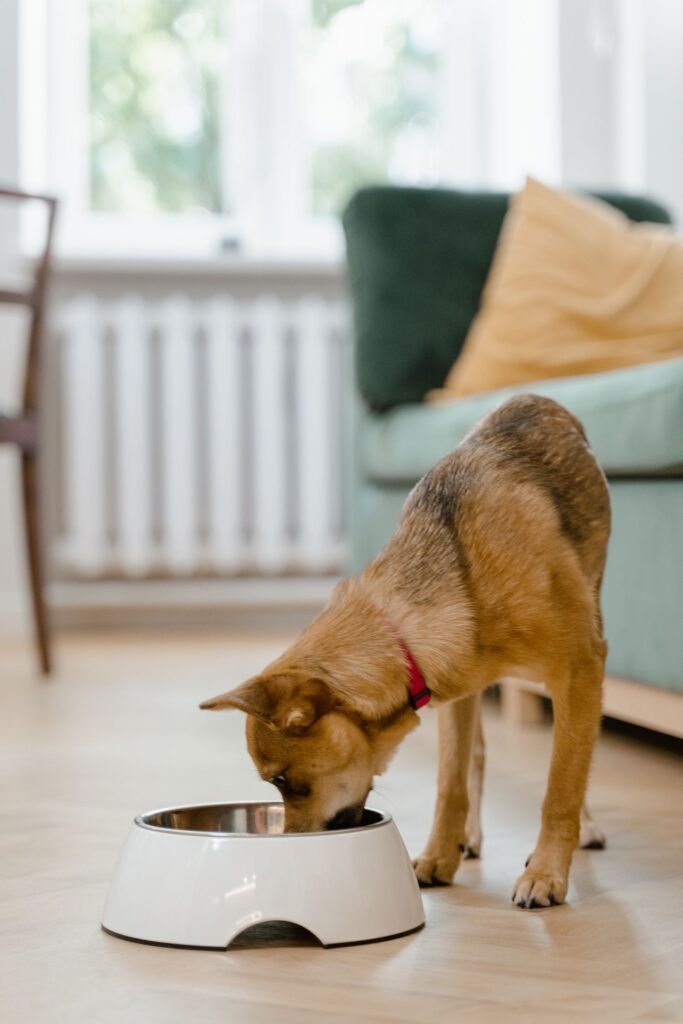
Scales beat cups every time
Measuring cups are convenient, but they are not precise. Research on pet owners measuring kibble with scoops has shown that portions can be wildly off, with errors large enough to cause weight gain over time. Kibble size and shape, how firmly the cup is packed, and whether it is level or heaped all change the amount. A digital kitchen scale costs very little and removes the guesswork. Weigh out the daily amount each morning into a container, then serve meals and any kibble-based training rewards from that container. When it is empty, your dog has had their food for the day.
How to use the Food Portions calculator
- Enter your dog’s weight in kilograms.
- Select the life stage: puppy, adult or senior.
- Choose an activity level that honestly reflects a typical week.
- Tell the tool whether your dog is neutered.
- Enter your food’s energy density (kcal per cup or per kg, as printed on the bag).
- Choose the number of meals per day.
- Get your result: the recommended daily ration and the amount per meal.
Write the number on a sticky note and put it on the food container so everyone in the house feeds the same amount.
How many meals a day?
The total daily amount matters most, but how you split it affects digestion, hunger and behaviour.
| Age | Suggested meals per day |
|---|---|
| 8 to 12 weeks | 4 |
| 3 to 6 months | 3 |
| 6 to 12 months | 2 to 3 |
| Adult | 2 |
| Senior | 2, or several smaller meals if appetite is poor |
Most adult dogs do well on two meals a day. Large, deep-chested breeds such as Great Danes, German Shepherds, Setters and Weimaraners are at higher risk of gastric dilatation-volvulus (bloat), a life-threatening emergency, and many vets recommend they eat at least two smaller meals rather than one large one and avoid vigorous exercise immediately before and after eating.
Feeding puppies: grow slowly, grow well
Puppies need more calories per kilogram than adults, but they also need the right balance of nutrients for healthy bones. Always use a complete food labelled for growth, and for large and giant breeds use a large-breed puppy formula with controlled calcium and energy. Overfeeding puppies, especially big breeds, can accelerate growth in a way that raises the risk of joint problems later in life.
Worked example: a four-month-old puppy weighing 10 kg, expected to reach 25 kg as an adult, has an RER of about 394 kcal. With a puppy factor of 2.0 that is roughly 790 kcal per day. On a puppy food containing 4,000 kcal/kg, that is around 197 g a day, or about 66 g per meal across three meals. Because puppies grow so fast, weigh them weekly and recalculate with the portion tool at least every two weeks.
Feeding adults and seniors
Adult dogs generally do best on a consistent routine: the same food, the same portion, at roughly the same times. As dogs age, many become less active and need fewer calories, but they still need good-quality protein to maintain muscle. Senior foods often contain slightly fewer calories and added joint support. Not every senior needs to switch, so base the decision on your dog’s body condition, health and your vet’s advice. Not sure if your dog counts as a senior yet? Our dog age calculator converts your dog’s age to human years and takes breed size into account.
Mixing wet and dry food
Many owners like to add a spoonful of wet food to kibble for flavour. That is fine, as long as you count it. Split the calories, not the grams. For instance, if your 20 kg dog needs 1,060 kcal and you want a quarter of the calories to come from wet food:
- Wet food: 25% of 1,060 = 265 kcal. At 1,000 kcal/kg that is 265 g of wet food.
- Dry food: 75% of 1,060 = 795 kcal. At 3,700 kcal/kg that is about 215 g of kibble.
Running the calculator once for each food at the percentage you want makes this quick and accurate.
Raw feeding and home-cooked diets
Raw feeders often use a rule of thumb of feeding 2 to 3% of an adult dog’s body weight per day. That can work as a rough guide, but raw diets vary hugely in fat content and therefore calories, so a fatty mince can deliver far more energy than a lean one. The calorie-first approach still applies: find the kcal content of the products you use and calculate grams from there. Home-cooked diets should always be formulated with a veterinary nutritionist, because it is very easy to miss essential vitamins and minerals.
Treats, chews and the 10% rule
Treats should provide no more than 10% of your dog’s daily calories. If you use a lot of treats for training, reduce the main meals slightly to compensate, or use part of the daily kibble ration as rewards. Remember that chews, bits of cheese, crusts and licked plates all count.
Monitoring and adjusting portions
Any calculated portion is a starting point. Dogs vary, and two dogs of the same weight can have quite different metabolisms. Use these checks to fine-tune:
- Weigh your dog every two to four weeks and note the results.
- Check body condition: ribs easy to feel under a thin layer of fat, a visible waist from above and a tummy tuck from the side.
- Adjust in steps of about 10%, then wait two to four weeks before changing again.
- Watch the poo: large, soft or frequent stools can be a sign of overfeeding or a food that does not suit your dog.
- Recalculate whenever you change food, as even different recipes from the same brand can vary in energy.
Switching foods safely
When you change food, introduce it gradually over seven to ten days to avoid tummy upsets. A common schedule is 25% new food for a few days, then 50%, then 75%, then 100%. Because the new food will almost certainly have a different calorie density, calculate the correct portion for it before you start, and blend the two portions in proportion.
Common portion mistakes to avoid
- Guessing with a scoop instead of weighing.
- Using the top of the bag’s feeding range.
- Forgetting to recalculate after neutering.
- Free-feeding (leaving food down all day), which makes it hard to track intake and often leads to weight gain.
- Not accounting for treats and table scraps.
- Feeding puppies an adult food, or large-breed puppies a standard puppy food.
- Keeping portions the same as an ageing dog slows down.
Feeding and the cost of dog ownership
Accurate portions are not only healthier, they also save money. If you are overfeeding by 15 to 20%, you are buying an extra bag of food every few months, and you are more likely to face vet bills for weight-related conditions. If you are still planning which dog to bring home, our dog breed selector helps you compare breeds by size, energy and budget, and the puppy cost calculator shows how food fits into the full cost of ownership.
Frequently asked questions
How much should I feed my dog per day?
It depends on your dog’s calorie needs and your food’s energy density. A neutered 20 kg dog with typical activity eating a 3,700 kcal/kg kibble needs roughly 286 g a day. Use the Food Portions calculator for an exact figure for your dog.
Is it better to feed by weight or by cups?
By weight. Cups measure volume, which varies with kibble shape and how you fill the cup. A kitchen scale is far more accurate.
My dog always seems hungry. Should I feed more?
Not necessarily. Many dogs, especially Labradors and Beagles, act hungry even when well fed. If your dog’s body condition is good, try adding low-calorie vegetables, using puzzle feeders or slow-feeder bowls, and splitting meals into smaller portions. If hunger is new or extreme, speak to your vet.
How do I know if the portion is right?
Your dog should hold a steady, healthy weight with easily felt ribs and a visible waist. If they are gaining or losing weight unintentionally, adjust by around 10% and re-check.
Conclusion
Getting dog food portions right is one of the simplest, cheapest and most effective things you can do for your dog’s health. Start with calories, find your food’s energy density, weigh rather than scoop, and adjust based on your dog’s body. With a reliable portion figure, every meal becomes a small investment in a longer, more active life together.